The Sun’s pattern
Klara and the SunThe Sun’s pattern is the recurring trace of sunlight across the store, Josie’s home, and the landscapes Klara observes. For Klara, it is more than a shifting visual feature: it appears to promise nourishment and strength, marks the Sun’s presence, and links her faith in solar care to the practical acts of looking after Josie. Its disappearance and return also give the pattern a fragile significance, exposing how dependent Klara’s understanding of safety is on light she cannot control.
Appearance and Early Meaning
At the store, Klara and Rosa first watched the Sun cross between the building tops from farther back in the shop. Once they were allowed to stand behind the window display, they could follow his journey toward the RPO Building. When the light reached them, Klara leaned her face forward to absorb as much nourishment as she could, and urged Rosa to do likewise. Their brief access to sunlight was framed by the store’s positions: after a minute or two they had to return to their places, where the Sun might not be visible.
Klara and Rosa worried that staying in mid-store without seeing the Sun would make them progressively weaker. Rex tried to reassure them, saying that the Sun could reach them wherever they were and pointing to a pattern of light on the floorboards as proof. He told them they could touch it to become strong again. The pattern therefore began as something both observable and interpretable: sunlight on the floor, but also a sign that the Sun’s nourishment could reach AFs beyond the window.
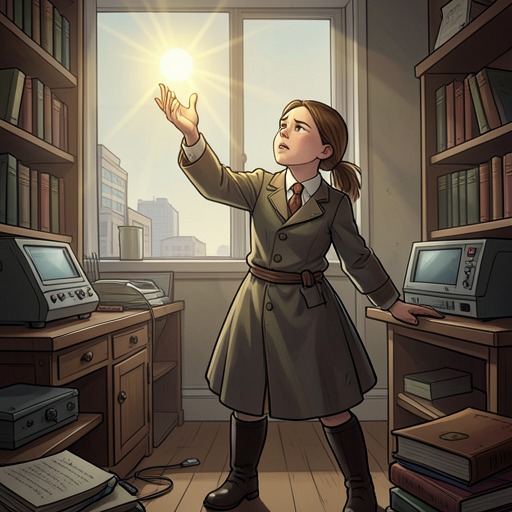
Klara tested Rex’s claim when the store was empty and the Manager was occupied at the Red Shelves. She crouched and reached with both hands toward the floor pattern. As soon as her fingers touched it, the light vanished. She patted the spot and rubbed her hands over the boards, but it did not return. Rex called her greedy, and Klara answered that he had said the Sun could reach them; she decided he must be teasing. Yet the attempt unsettled her because it seemed to touch on a subject AFs preferred not to discuss. The episode leaves the pattern suspended between visible evidence and an uncertain promise: Klara cannot make it deliver strength by touch, but neither does the failed experiment erase her belief in the Sun’s care.
The Store: Display, Nourishment, and Pollution
The pattern is also part of the store’s visual order, falling across AFs as they wait to be chosen. When Rex was moved to the front alcove, Klara and Rosa watched him stand with his chin raised and sunlight patterned over him. Rosa admired how wonderful he looked and expected that he would soon find a home. The light thus serves at once as nourishment in Klara’s understanding and as a feature of an AF’s public presentation: Rex appears especially striking in the position where customers’ gaze first falls.
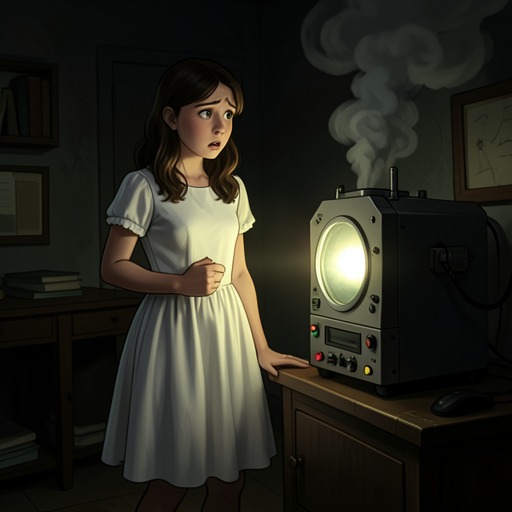
The Cootings Machine’s pollution later put that promise under pressure. Smoke darkened the daytime until it resembled night, and Klara could no longer find the Sun’s patterns on the floor, alcoves, or walls. Near the end of the second bad afternoon, the pattern reappeared faintly despite the worsening smoke. Klara asked the Manager whether the AFs would still receive all their nourishment. The Manager dismissed the danger, saying the machine had visited before without anyone in the store suffering and telling Klara to put it out of her mind.
After four continuous days of pollution, Klara could feel herself weakening. Long periods without customers left her less able to maintain her posture, and Rex had to touch her arm to make her stand straight again. The episode makes the pattern’s absence consequential rather than merely atmospheric: its disappearance coincides with Klara’s bodily decline, while the returning light is too faint to reassure her fully. When the machine and its special section were removed, the pollution cleared, the sky turned brilliant blue, and the Sun’s nourishment poured into the store again. The restored light accompanied a broader rise in spirits, but it did not bring Josie back; Klara eventually stopped watching the street for her and turned instead to learning about the outside.
At Josie’s House: Light and Attentive Care
At Josie’s house, the pattern belongs to a different kind of space. The kitchen has large windows facing a wide sky and an outdoors nearly empty of traffic and passers-by; the road rises over a hill beyond distant trees. A skylight in the high ceiling can be opened or concealed by remote control. The kitchen often fills with what Klara calls the Sun’s best nourishment, and at first she worries when Melania Housekeeper draws the blind over the skylight while sunlight is coming in.
Observation changes Klara’s response. She sees that Josie can become too warm when the Sun’s pattern falls too intensely over her, and learns to use the remote herself. The light that once seemed simply beneficial now has to be considered in relation to Josie’s condition. Klara’s care involves neither rejecting the Sun’s nourishment nor treating it as unconditionally harmless; she watches its effect and adjusts the skylight when the pattern becomes too strong. The recurring image thus connects Klara’s solar faith to her developing attentiveness to another person’s physical needs.
The bedroom rear window extends the pattern’s setting from an enclosed room to the fields and horizon. Josie and Klara kneel on the soft cream couch Klara calls the Button Couch, resting their arms against its cushioned back to watch the Sun’s last part of the journey. Josie understands how much Klara enjoys this view and makes time for it when possible. Once, while Josie and the Mother were talking at the kitchen Island, Klara stood by the refrigerator to give them privacy. Josie interrupted her mother to ask whether she and Klara could go upstairs before the sunset was missed. The pattern’s significance here is relational as well as visual: Josie recognizes Klara’s attachment to watching the Sun and accommodates it within their shared routines.
Recurrence Across Space and Story
The pattern reappears in markedly different surroundings, and those changes give it a structural role in Klara’s experience. At the store it is a local patch of light on the floorboards and over the waiting AFs; under the pollution it is nearly erased; at Josie’s house it enters through windows and a controllable skylight; from the bedroom, sunlight can be followed across three adjoining fields to the horizon. The recurring image links these places without making their conditions identical. In the store, Klara worries that she cannot see the Sun from her assigned position; at home, she can manage the skylight but must also account for Josie’s warmth.
During a car journey, the outside view changes rapidly across Klara’s visual boxes. Cars appear from far away and pass in both directions, while pieces of road and field shift between the boxes. Klara cannot preserve the road as one continuous line, so she allows it to break and begin again at each border. In that unsettled view, the Sun’s patterns sometimes fall across an entire valley or sweep of land. The pattern has expanded from a small, apparently touchable patch on a shop floor to light spanning a landscape too broad to fit within Klara’s changing visual arrangement.
This movement also clarifies the limits of what the pattern can promise. Klara once believes contact with a patch of sunlight might restore strength, but it disappears at her touch; later, visible patterns can vanish under pollution even as the Sun is, in her belief, trying his utmost. At Josie’s house, light can nourish but can also become excessive for Josie. Across these episodes, the pattern remains an observable sign whose meaning depends on circumstance, not a guarantee that danger or weakness will be removed. Its recurrence gives form to Klara’s sustained attention: she watches where sunlight falls, interprets what its presence or absence might mean, and adjusts her actions in response to the people and places before her.